 ApexGamerVerse
Why Apex Legends' LTMs Are the Secret to Its Lasting Appeal
Apex Legends limited-time modes fuel player engagement and stealthily test gameplay evolutions that reshape the battle royale's meta.
I still remember the first time I dropped into an Apex Legends limited-time mode. It was a complete departure from the usual battle royale chaos—new rules, altered loot, or a sudden twist that made me rethink every instinct I'd built over hundreds of hours. That feeling of refreshing disorientation is exactly why I keep coming back, and by 2026, it's become clear that LTMs are more than just a distraction; they’re the heartbeat of how Respawn keeps the game alive.
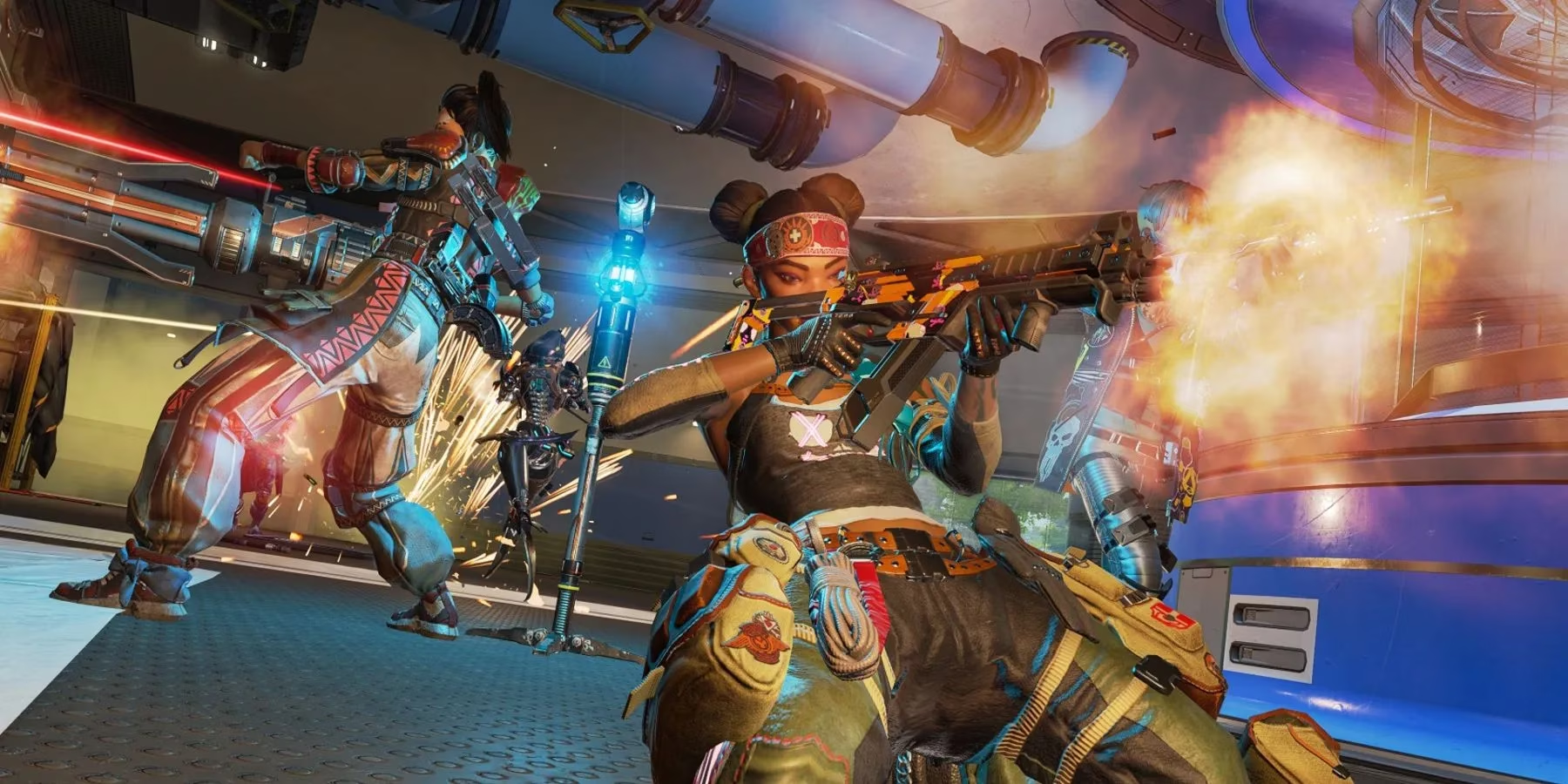
When you've been playing a game as long as I have—since the early days of Kings Canyon—monotony is the real enemy. The standard battle royale loop can start to feel like a familiar script: land, loot, fight, die, repeat. But an LTM slices through that routine like a Kraber shot. Take my recent obsession with the mode called "Revival," which Respawn introduced a few seasons back. Every time you drop, you get a temporary respawn token, turning the mid-game into a relentless ballet of aggression and second chances. It’s pure adrenaline, and it made me ask: why can’t the main game feel like this all the time? That question, right there, is why Respawn builds these modes.
The Laboratory Disguised as a Playground
What many players don’t realize—or maybe we do, deep down—is that every LTM is an experiment wearing a party hat. Back in 2020, I remember grinding an LTM called "Always Be Closing" for the first time. It was chaotic, with the ring constantly moving and no room to breathe. But tucked inside that frantic experience was a little thing called the Evo Shield. At first, I hated it. A shield that levelled up based on damage dealt? It punished passive play. But after a week, I couldn’t imagine playing without it. The progression felt rewarding, and it turned petty skirmishes into strategic investments. Respawn noticed the overwhelmingly positive feedback, and Evo Shields became a permanent fixture. That’s the magic: we’re not just playing for fun; we’re unknowingly voting with our triggers and thumbs.
This philosophy hasn’t changed in 2026. If anything, it’s become more aggressive. LTMs now regularly test new weapon balancing, map evolutions, and even experimental character abilities. A recent LTM quietly adjusted the Wingman’s headshot multiplier in real-time, gathering data before a full patch. When I jump into these modes, I feel less like a consumer and more like a co-designer. It’s almost unnerving to think: is my elation or frustration right now going to rewrite the next meta?
Keeping the Familiar Fresh
Let’s be honest: Apex Legends is a game of muscle memory. You learn mouse flicks for the Peacekeeper, you memorize the sound of a distant Sentinel, and you build a sixth sense for third-party timing. That mastery is satisfying, but it’s also a cage. LTMs are the key. They force me to unlearn and adapt. When Control mode first dropped as an LTM, suddenly my survival instincts were useless—I had to capture zones and chain spawns like a frontline soldier. I fumbled, I raged, and then I loved it so much that it eventually became a permanent playlist.
In 2026, the variety has only deepened. I’ve experienced modes where gravity is halved, where only pistols spawn, or where each squad has a randomly assigned “VIP” that must survive at all costs. Some modes are absurdly casual; others are sweatier than Ranked. The table below sums up my emotional rollercoaster across some memorable LTM types:
| LTM Type | What It Changed | My Honest Reaction |
|---|---|---|
| Weapon-Locked (e.g., Shotguns & Snipers) | Drastically altered combat distance | 😤 Frustration at first, then 🤯 pure skill reset |
| Respawn Tweaks (e.g., Revival) | Death became temporary | 🥳 Constant action, less downtime in lobby |
| Map Modifiers (e.g., Lava Rising) | Environmental hazards evolved mid-match | 🏃♂️ Heart-pounding rotations, no camping |
| Ability Mayhem (e.g., Ultra-Abilities) | Legend abilities supercharged | 🤪 Beautiful chaos, no clue what’s happening |
A Trend Across the Genre
Apex isn’t doing this in a vacuum. I’ve seen Fortnite use LTMs to trial entire traversal mechanics before they hit the main island. Call of Duty: Warzone’s LTMs often hint at map changes or new contracts, though sometimes they arrive clunky and break more than they build. Even Overwatch 2’s arcade modes have morphed into a testing ground for hero reworks. The difference with Apex, in my eyes, is the seamless connection between testing and storytelling. When an LTM alters something, Respawn often leans into the lore—explaining a map change or a new weapon’s arrival through in-game events. It makes me care about the experiment beyond just the mechanics.
Where Do We Go from Here?
As 2026 unfolds, the line between LTM and core game continues to blur. I wouldn’t be surprised if Respawn’s next big innovation—maybe a full-fledged PvE mode or a completely dynamic map that reshapes based on player actions—first sneaks in disguised as a weekend event. The question I keep asking myself is: what’s left to test? With almost seven years of evolution, Apex has already subverted the battle royale formula more times than I can count. But then I remember the thrill of that first respawn token, or the panic of a closing ring that wouldn’t stop, and I realize that the well of creativity is nowhere near dry. The LTMs are a constant reminder that this game can still surprise me. And that, more than any badge or rank, is why I’ll still be logging in tomorrow.
Apex Legends continues to thrive across PC, consoles, and mobile—powered, in no small part, by the humble limited-time mode that never stops asking, "What if?"