 ApexGamerVerse
Catalyst's Resonance: A Trans Voice in the Outlands and the Journey of Representation
Apex Legends introduces Catalyst, the first trans Legend, voiced by trans actor Meli Grant, marking a bold leap for authentic representation.
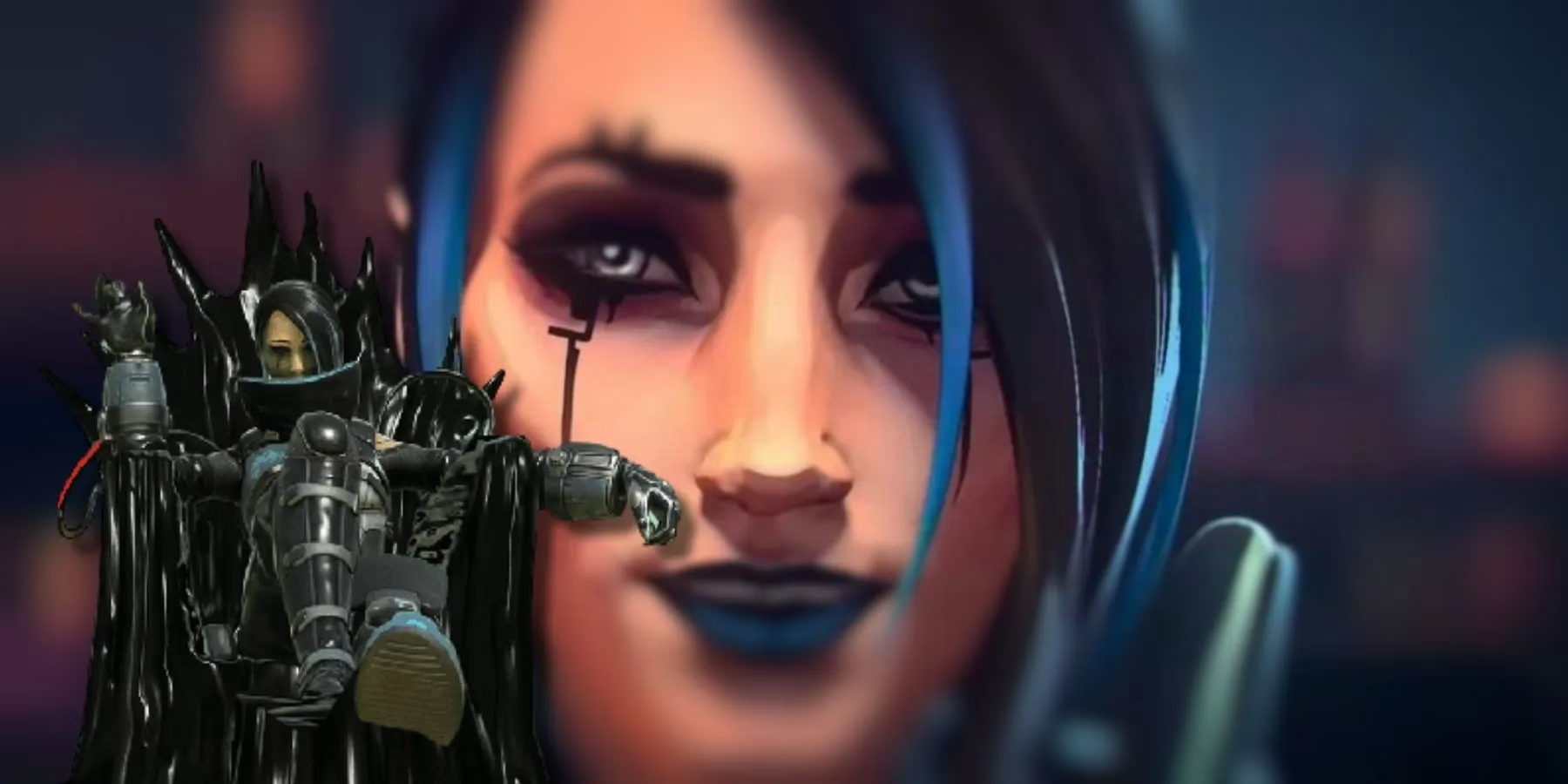
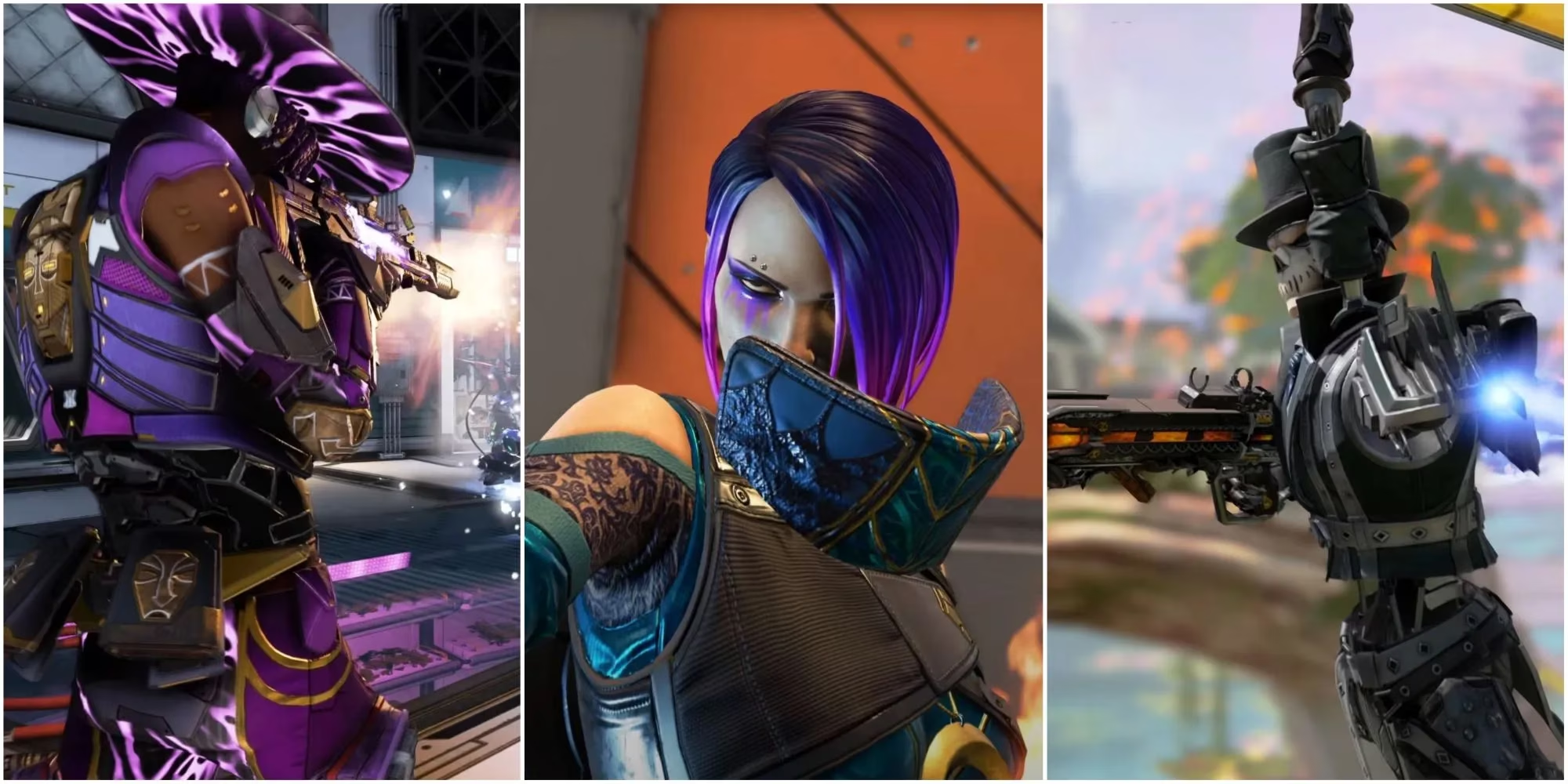
The ever-expanding universe of Apex Legends welcomes a new dawn with Catalyst, a Legend who is much more than her formidable ferrofluid abilities. She arrives not just as a defensive tactician who can reshape the battlefield with walls and sealed doors, but as a groundbreaking figure: the first openly trans character to join the Apex Games. Voiced by the immensely talented trans voice actor Meli Grant, Catalyst's introduction is a powerful step toward normalizing trans stories in mainstream gaming. Her presence is a testament to the idea that representation isn't just a checkbox; it's about weaving authentic, multi-layered lives into the fabric of the worlds we escape to. This isn't just a new meta; it's a new chapter.
The Voice Behind the Walls: Navigating Identity and Industry
For Meli Grant, stepping into Catalyst's boots was a journey that mirrored the character's own path of self-discovery. In an industry where prominent trans voice actors can still be counted on one hand, Grant is acutely aware of being a role model. "There are a lot of eyes on us," she reflects, conscious of the message it might send to aspiring actors. The pressure to "get over" vocal dysphoria and perform across a wide gender range can be immense, but Grant champions a different path: finding your authentic range and thriving within it. "You can find a range where you feel safe playing in, and then find success doing that. Nobody needs to play both male and female archetypical characters," she asserts, pushing back against an unrealistic standard seldom placed on cis actors.
Grant's own path was not a straight line. Transitioning in her late 20s, she once feared it meant the end of her acting dreams. "I thought that was me throwing away any chance I had of being an actor," she admits. The process of rediscovering her voice as a performer was a years-long odyssey. Initially gravitating toward "strong, commanding, powerful" female archetypes, she was challenged to explore a more "femme fatale" persona—a muscle she had to develop. Catalyst became the perfect culmination of that work, a character Grant describes as "Batwoman with a little extra sultry," blending the seriousness of Wraith, the allure of Loba, and the deadly focus of Ash.
More Than a Label: Catalyst as a Three-Dimensional Person
What makes Catalyst resonate so deeply is that her trans identity is integral but not all-consuming. "One thing that was important for Catalyst was that we didn't need to tell a transition story or a story that was about bigotry," Grant explains. The Outlands, thankfully, are not a bigoted place. Instead, Catalyst is a fully realized person with a life beyond the Games. She's an environmental activist fighting corporate exploitation on her home moon, Broken Moon. She has complex relationships, hobbies, and a sardonic, dark sense of humor forged as a coping mechanism in a world that can feel inherently hostile.
This humor, and her defensive kit, speak volumes. "She has her walls up," Grant says, referencing both her personality and her in-game abilities to seal doors and erect barriers. "It does feel like Catalyst's abilities could be the outward expression of her coping mechanisms." The journey from the bright-eyed teenager in the lore trailer to the guarded, intense competitor in the present-day Games shows a person who has built emotional fortifications. Yet, there's hope for thawing, for re-finding light—a narrative arc as compelling as any battle royale.
Building a Support System: In-Game and IRL
Catalyst's story subtly underscores the profound importance of community. "We're strongest when we work together," Grant notes, drawing a parallel to how she and other trans and non-binary friends support each other through dark times. This theme of mutual defense echoes in the game's very design, where Catalyst's structures protect her squad. The supportive outreach from fellow Apex Legends cast members when her role was announced mirrored this ideal. Having a support system, Grant emphasizes, is crucial for stability, a reminder "that you're not alone and that you are enough."
This need for support extends to handling the inevitable negativity that comes with visibility. For Grant, handling trolls is a careful calculation. Her approach is often to hide, mute, and block, avoiding the risk of "kicking the hornet's nest." When she does engage, she aims for a teaching moment. Responding to a hateful message, she simply outlined her normal life: "I work, I pay my rent, I try to eat well... That's pretty normal to me." It's a powerful rebuttal to dehumanizing strawman arguments, asserting the simple, relatable humanity often denied to marginalized groups.
The Nuances of Transition in a Futuristic World
Catalyst's backstory presented a unique narrative challenge: in the advanced, accepting Outlands, why would she wait until her teenage years, after a testosterone puberty had begun, to transition? The answer the team crafted is beautifully nuanced and free of bigotry. It centers on the internal anxieties of a teenager worried about the ripple effects of her transition on her family and friends—the social awkwardness, the conversations others would have to have. "For everyone else's sake Catalyst may have dragged her feet a little bit," Grant explains, highlighting a universal teenage desire to not rock the boat. This creates a relatable bridge for players who may have delayed their own truths for complex, personal reasons, even in the absence of overt prejudice.
This depth extends to her vocal evolution. The slightly higher, softer voice in her youth trailer versus the deeper, confident tone in-game mirrors a common trans experience. "I had a moment... where I tried to pitch a lot higher," Grant shares from her own life, viewing Catalyst's shift as her "settling into herself" and discovering what femininity truly means to her—a journey that is never static.
Advocacy Beyond the Booth: Industry Realities
Grant's perspective on representation extends to the industry's economic realities. While she expresses deep gratitude for her treatment by Respawn Entertainment and EA—noting that working on Apex has been a leading contributor to her finally accessing quality healthcare—she is clear-eyed about broader issues. The recent Bayonetta 3 pay controversy highlights a systemic problem: the vast disconnect between a franchise's revenue and the compensation for the voice talent that helps make it successful.
"Residuals don't exist anymore," she states plainly. She points to the anime industry's history of paying paltry hourly rates for work on multimillion-dollar properties, citing her housemate's experience. The goal, she argues, should be a "new normal" where compensation better reflects a project's success. "The bar shouldn't definitely be at 'Hopefully I get healthcare.' I think we can do better as an industry."
A Proof of Concept for the Future
Ultimately, Meli Grant hopes Catalyst serves as a powerful proof of concept. First, that trans stories are wanted, needed, and profitable. "Often times we see that when we do representation right it makes money." Second, and more personally, that trans talent can compete and excel at the highest professional levels. The aspiration is not just to play trans characters but to be considered for all roles, while also ensuring marginalized communities have the opportunity to tell their own stories.
As for other games, Grant, an avid Destiny 2 fan, expresses a desire to see its universe expand its queer representation, especially with the new civilizations introduced in Lightfall. "I would love to see more," she says, ending with a hopeful, "And also cast me!"
Catalyst's arrival in the Outlands is more than a seasonal update; it's a cultural moment. She stands as a complex, proud, and powerfully capable character whose identity is a facet of her brilliance, not its sole definition. Through Meli Grant's passionate and insightful portrayal, Catalyst doesn't just change the game's meta—she helps change the game itself, paving the way for a future where every player can see a richer, more authentic reflection of the world in the legends they champion. The walls are up, but the doors to a more inclusive universe are finally, irrevocably, open.